Library

Docs
Beta

Products

Adding Additional Instances To ClusterAlerting On Log EventsAnalyzing LogsAuthenticating and Importing Users with AD and LDAPChanging Data Store PathConfiguring FiltersConfiguring InputsConfiguring Multi Tenancy in Nagios Log ServerConfiguring NXLog To Send Additional Log FilesCreating a Log Server DashboardForwarding Logs from Nagios Log Server to Another DestinationHow To Configure NXLog To Send Multi line Logs To Nagios Log Server.How To Configure Windows To Send Logs To Nagios Log ServerHow To Create A Nagios Log Server Instance In The Amazon EC2 CloudHow To Export Or Schedule Reports In Nagios Log ServerHow To integrate Nagios Log Server with XIHow to Backup and Restore the Nagios Log ServerHow to use a Proxy Server with Nagios Log ServerIntegrating Nagios Log Server with Nagios XILog Server Dashboard OverviewManaging ClustersManaging IndicesManaging Snapshots and MaintenanceMonitoring A New Log SourceMonitoring Apache Logs with Nagios Log ServerMonitoring Linux System Logs using Nagios Log ServerMonitoring Squid Proxy Server With Nagios Log ServerNagios Log Server Adding Additional Instances To ClusterNagios Log Server Administrator GuideNagios Log Server Alerting On Log EventsNagios Log Server Analyzing LogsNagios Log Server Architecture and Overview NWC15Nagios Log Server Changing Data Store PathNagios Log Server Cluster Timezone SettingsNagios Log Server Configuration OverviewNagios Log Server Configuring Input FiltersNagios Log Server Configuring InputsNagios Log Server Configuring NXLog To Send Additional Log FilesNagios Log Server Configuring NXLog To Send Multi Line Log FilesNagios Log Server Conversion for VirtualBoxNagios Log Server Custom Alert Message Email TemplateNagios Log Server Data Backup and ArchivingNagios Log Server ELK documentationNagios Log Server ESXi Syslog ConfigNagios Log Server Exporting Log DataNagios Log Server Full Architecture OverviewNagios Log Server How To Configure SSLNagios Log Server How To Create A Nagios Log Server Instance In The Amazon EC2 Cloud EnvironmentNagios Log Server How To Install Using VMwareNagios Log Server How To Select A DownloadNagios Log Server Important Files And DirectoriesNagios Log Server Introduction WebinarNagios Log Server Jobs Subsystem ArchitectureNagios Log Server License EntitlementsNagios Log Server Listening On Privileged PortsNagios Log Server Log Monitoring and Log Management with Nagios NWC14Nagios Log Server Logging InNagios Log Server Managing ClustersNagios Log Server Managing IndicesNagios Log Server Managing InstancesNagios Log Server Managing Snapshots and MaintenanceNagios Log Server Managing UsersNagios Log Server Monitor Your Log Server InstancesNagios Log Server Monitoring A New Log SourceNagios Log Server Offline UpgradeNagios Log Server Overview And TerminologyNagios Log Server Performance And Storage WalkthroughNagios Log Server Poller Subsystem ArchitectureNagios Log Server Real Life Experience of Nagios Log Server NWC15Nagios Log Server Removing An Instance From A ClusterNagios Log Server Sending Multiline Log Files Using SyslogNagios Log Server Sending NXLogs With SSLNagios Log Server Sending Nagios Core Logs To Nagios Log ServerNagios Log Server Sending syslog with SSL/TLSNagios Log Server Single Instance DeploymentNagios Log Server Updating Logstash PatternsNagios Log Server Upgrade InstructionsNagios Log Server Using An Output To Create Nagios XI Passive ObjectsNagios Log Server Using GeoIP DataNagios Log Server Using The Custom Includes PageRemoving An Instance From A ClusterSend Alerts Based on the Log Server Audit LogSending ESXi Logs To Nagios Log ServerSending Mac OS X Logs To Nagios Log ServerSending NXLogs With SSL/TLSSending Nagios Core Logs To Nagios Log ServerSending syslog With SSL/TLSUpgrade Nagios Log ServerUsing An Output To Create Nagios XI Passive ObjectsWaiting for Database StartupNagios Log Server Monitoring Using NCPA + Nagios XI

Nagios Log Server - Monitoring Using NCPA + Nagios XI

Overview

This KB article shows you how to monitor a Nagios Log Server cluster using the Nagios Cross-Platform Agent (NCPA) and Nagios XI.

Requirements

This KB article assumes that you have:

  • Nagios Log Server 2024R2+
  • Nagios XI 2024R1+
  • A valid network connection between these servers

Managing the Agent

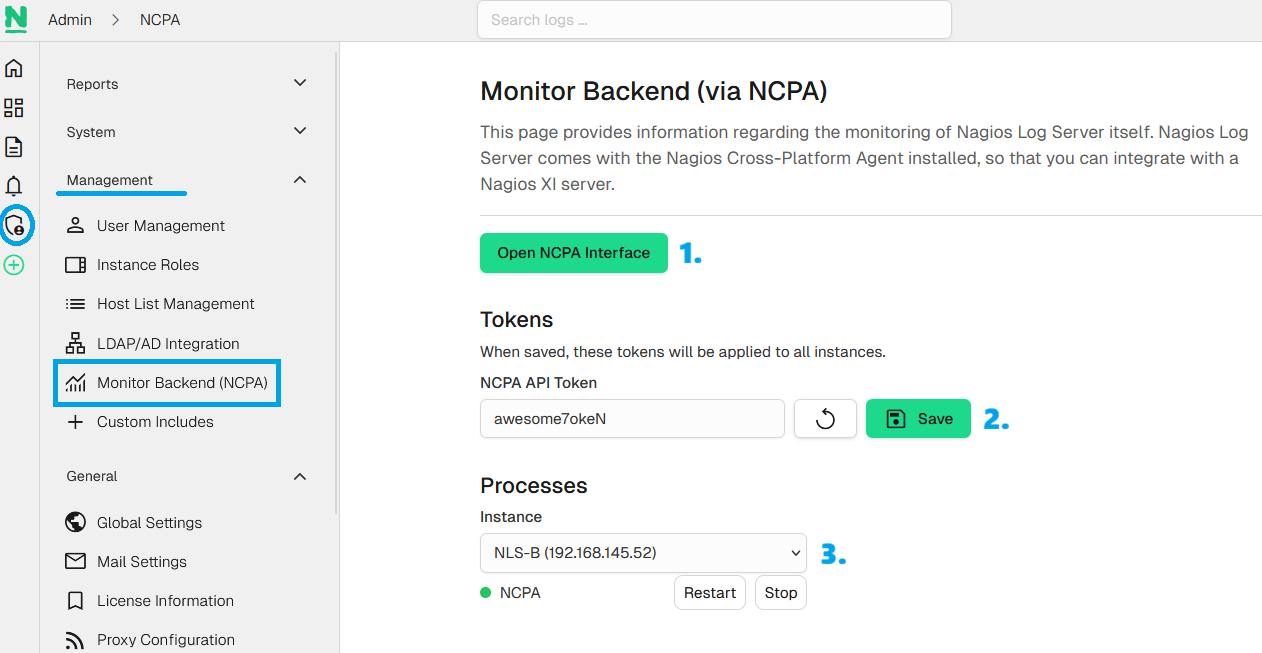
The Nagios Cross-Platform Agent (NCPA) now ships by default with Nagios Log Server. A specialized management page is also available, at Admin > Management > Monitor Backend (NCPA).

On the page you should see 3 sections:

1. At the top, a button labelled Open NCPA Interface. This will open the main web interface for the agent on the selected cluster instance.

2. A Tokens management form.

Setting the token with this form will allow you to apply the same token to every agent on the cluster with one click. 

If you're using HTTPS, make sure that you've accepted the certificate in your browser, otherwise this will only work for the current machine.

3. A Processes section.

At the bottom, you will see a display that allows you to view and manage the NCPA processes for all members of the cluster.

You can switch the viewed instance by clicking the drop-down menu labelled Instance.
Monitoring

To monitor the NLS cluster, go to your Nagios XI Interface, and go to Configure > Configuration Wizards > NCPA.

Most of this configuration wizard should be self-explanatory. However, at the bottom of Step 2 you will see a Plugins section with two special plugins listed:
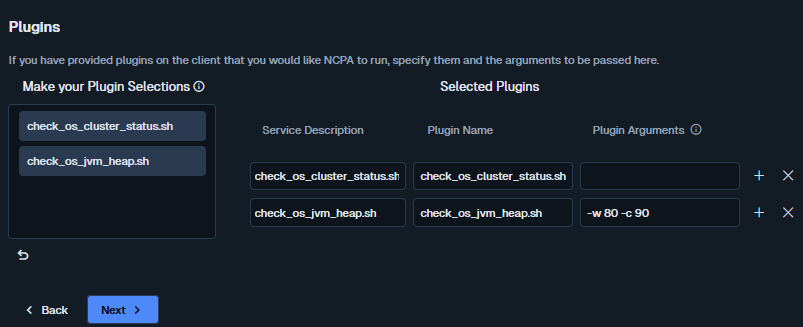
To select a plugin, click the list icon to the right of the second box.

If check_os_cluster_status.sh is selected, Plugin Arguments should be left blank.

This plugin simply checks the Opensearch cluster status, and alerts OK/WARNING/CRITICAL based on whether status is GREEN/YELLOW/RED. Since 1-instance clusters YELLOW at best, these will also output an OK status.

If check_os_jvm_heap.sh is selected, warning and critical thresholds should be specified in the usual way, and expressed as a percentage of the total desired elasticsearch JVM heap usage. For instance, you may choose arguments like:

-w 80 -c 90

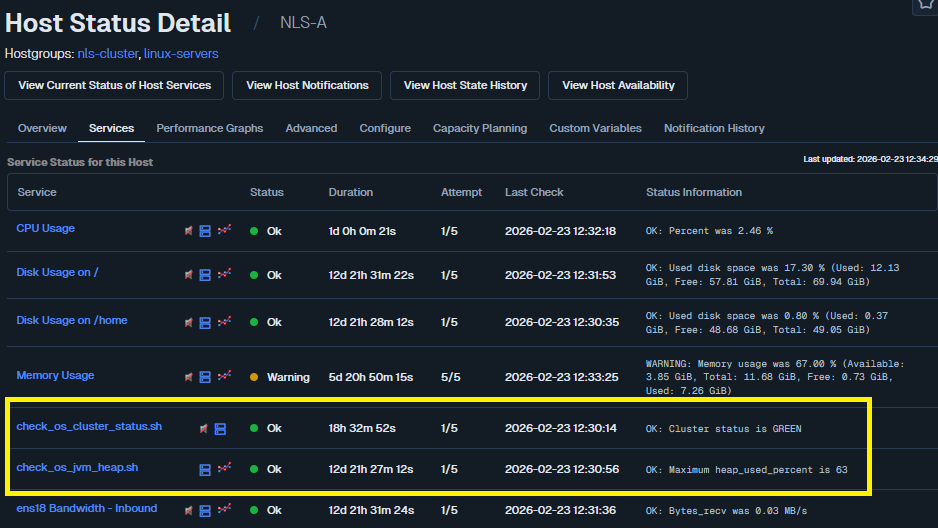
When finished, click the Next button until configuration is applied. If you've done everything correctly, you should see the normal NCPA service status alongside the custom plugins:
Final Thoughts

For any support related questions please visit the Nagios Support Forum at:

http://support.nagios.com/forum/

Nagios Enterprises, LLC

© All rights reserved. 2026